
Introduction
The BVOSTFUS Python issue fix process focuses on identifying and resolving problems that occur while installing, configuring, running, or maintaining Python environments. Python is widely used for software development, automation, data analysis, artificial intelligence, web applications, and scripting. However, incorrect configurations, incompatible packages, missing dependencies, and environment conflicts can prevent Python programs from working correctly.
Python issues are often caused by factors outside the Python language itself. A script may fail because of an incorrect Python version, a broken package installation, an outdated dependency, incorrect system variables, or conflicts between multiple development environments. Understanding the root cause is more effective than applying random fixes because temporary solutions can create additional problems later.
A systematic BVOSTFUS Python issue fix approach helps developers, students, and technical users diagnose errors efficiently. Instead of reinstalling Python repeatedly or changing settings without understanding the cause, users can follow a structured troubleshooting workflow that identifies the problem area and applies the correct solution.
This guide explains common Python problems, their causes, troubleshooting methods, and preventive practices. It covers installation failures, dependency conflicts, virtual environment problems, PATH configuration issues, runtime errors, package management challenges, and long-term maintenance strategies.
What Causes BVOSTFUS Python Issues?
Python environments depend on multiple components working together. These components include the Python interpreter, operating system settings, installed libraries, package managers, project files, and development tools. A failure in any one component can affect the complete workflow.
Many users experience Python errors because they focus only on the visible error message instead of investigating the underlying cause. For example, a “module not found” error may not mean the module is unavailable. It may indicate that the package was installed in another environment or that the wrong Python interpreter is being used.
Understanding common causes makes the troubleshooting process faster and more accurate.
Common Reasons Behind Python Problems
| Problem Area | Common Cause | Possible Result | Recommended Fix |
| Python Installation | Incorrect installation process | Python commands do not work | Reinstall Python correctly |
| PATH Configuration | Missing environment variables | Terminal cannot find Python | Add Python path manually |
| Package Management | Missing or incompatible packages | Import errors | Update or reinstall dependencies |
| Python Version | Version mismatch | Application crashes | Use compatible Python version |
| Virtual Environment | Incorrect activation | Packages unavailable | Activate correct environment |
| System Permissions | Limited access rights | Installation failures | Run with proper permissions |
| Cache Files | Corrupted package cache | Installation errors | Clear package cache |
Checking the Python Installation Before Applying Fixes
Verify Python Version and Installation Status
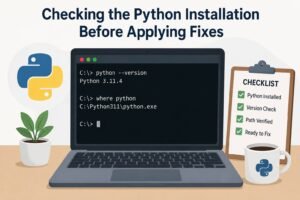
The first step in any BVOSTFUS Python issue fix process is confirming whether Python is installed correctly. Many troubleshooting attempts fail because users modify packages or project files before confirming the basic Python setup.
Open a command prompt or terminal and check the installed Python version:
bash
CopyEdit
python –version
or:
bash
CopyEdit
python3 –version
A valid installation should return a version number such as Python 3.11 or Python 3.12.
If the command returns an error, the system may not recognize Python. This usually indicates an installation issue or a missing PATH configuration.
Why Python Verification Matters
Checking the installation provides important information:
- It confirms whether Python exists on the system.
- It identifies the currently active Python version.
- It helps detect conflicts between multiple Python installations.
- It prevents unnecessary package troubleshooting.
Ignoring this step can lead to fixing the wrong problem. For example, installing packages with one Python version while running code with another version can create confusing errors.
Recommended Installation Validation Steps
Before continuing, verify:
- Python launches successfully from the terminal.
- The correct Python version is installed.
- The package manager works properly.
- The environment points to the expected Python interpreter.
You can check the package manager using:
bash
CopyEdit
pip –version
If both Python and pip respond correctly, the installation foundation is usually working.
Fixing Python PATH Configuration Problems
What Is a PATH Error?
A PATH configuration issue occurs when the operating system cannot locate the Python executable. When users type Python commands, the system searches through predefined locations stored in the PATH variable.
If Python’s installation directory is missing from PATH, commands such as python or pip may fail.
Common error messages include:
- “Python is not recognized as an internal or external command.”
- “Command not found.”
- “pip is not recognized.”
Why PATH Configuration Matters
The PATH variable allows applications and development tools to communicate with Python. Without proper configuration:
- Terminal commands fail.
- IDEs cannot detect Python.
- Package installation becomes difficult.
- Automation scripts may stop working.
How to Fix Python PATH Issues
Follow these steps:
- Locate the Python installation folder.
- Copy the Python installation path.
- Add the folder location to system environment variables.
- Restart the terminal.
- Verify the installation again.
On Windows systems, Python installation usually includes an option:
“Add Python to PATH”
Selecting this option during installation prevents many configuration problems.
Resolving Python Package and Dependency Errors
Understanding Dependency Problems
Python projects rarely operate with only the standard library. Most applications depend on external packages installed through pip. These packages may have their own requirements and compatibility limitations.
Dependency problems occur when:
- A package is missing.
- A package version is incompatible.
- Two libraries require different versions.
- Installation files become corrupted.
A common example is:
vbnet
CopyEdit
ModuleNotFoundError: No module named ‘package_name’
This indicates that Python cannot locate the required package.
Why Dependency Management Is Important
Poor dependency management creates unstable environments. A project that works on one computer may fail on another because different package versions are installed.
Professional Python development requires consistent dependency handling.
Practical Package Troubleshooting Steps
Check Installed Packages
Use:
bash
CopyEdit
pip list
This displays installed libraries.
Install Missing Packages
Example:
bash
CopyEdit
pip install package_name
Update Existing Packages
Use:
bash
CopyEdit
pip install –upgrade package_name
Review Project Requirements
Many projects include:
CopyEdit
requirements.txt
Install all dependencies using:
bash
CopyEdit
pip install -r requirements.txt
Fixing Virtual Environment Problems in Python
What Is a Python Virtual Environment?
A virtual environment creates an isolated Python workspace where projects can maintain separate dependencies.
For example:
- Project A may require Django version 4.
- Project B may require Django version 5.
Installing both globally can create conflicts. Virtual environments prevent these issues.
Common Virtual Environment Errors
Users may experience:
- Packages missing after installation.
- Incorrect Python interpreter selected.
- Environment activation failures.
- Dependency conflicts.
Why Virtual Environments Matter
Virtual environments provide:
- Better project organization.
- Dependency isolation.
- Easier deployment.
- More reliable development workflows.
Without isolation, updating one package may break unrelated projects.
Virtual Environment Troubleshooting Steps
Create a new environment:
bash
CopyEdit
python -m venv environment_name
Activate it:
Windows:
bash
CopyEdit
environment_name\Scripts\activate
Linux/macOS:
bash
CopyEdit
source environment_name/bin/activate
Verify the active interpreter:
bash
CopyEdit
where python
or:
bash
CopyEdit
which python
Handling Python Version Compatibility Issues
Why Python Versions Create Problems
Python receives regular updates that introduce new features, security improvements, and performance changes. However, newer versions may not always support older libraries.
A project created using Python 3.9 may behave differently when executed on Python 3.12.
Common Compatibility Problems
Examples include:
- Deprecated functions.
- Unsupported package versions.
- Syntax differences.
- Library installation failures.
Recommended Solution
Before upgrading Python:
- Check project requirements.
- Review package compatibility.
- Test changes in a separate environment.
- Keep backups of working configurations.
A controlled upgrade process prevents unexpected failures.
Troubleshooting Python Runtime Errors
Understanding Runtime Errors
Runtime errors occur while a Python program is executing. Unlike installation problems, Python starts successfully but fails during operation.
Common examples include:
- Type errors.
- File handling errors.
- Database connection issues.
- API communication failures.
Common Runtime Error Categories
| Error Type | Meaning | Solution |
| SyntaxError | Incorrect code structure | Review code syntax |
| TypeError | Invalid operation between data types | Check variable types |
| ValueError | Incorrect value provided | Validate input data |
| ImportError | Missing dependency | Install required package |
| FileNotFoundError | Missing file location | Verify file path |
Recommended Debugging Approach
When a runtime error occurs:
- Read the complete error message.
- Identify the file and line number.
- Check recent code changes.
- Test smaller sections of code.
- Review documentation for affected libraries.
Fixing Python Installation and Update Failures
Why Installation Failures Occur
Python installation problems can happen because of:
- Interrupted downloads.
- Permission restrictions.
- Antivirus interference.
- Existing conflicting installations.
Recommended Installation Practices
Before installing Python:
- Remove unnecessary old versions.
- Download Python from official sources.
- Enable PATH configuration.
- Confirm installation after completion.
Avoid installing multiple Python versions unless there is a specific development requirement.
BVOSTFUS Python Issue Fix Troubleshooting Workflow
A structured workflow reduces troubleshooting time and prevents unnecessary changes.
Step 1: Identify the Error
Start by understanding:
- What action caused the problem?
- What error message appeared?
- When did the issue begin?
Avoid making changes before understanding the failure.
Step 2: Check the Environment
Verify:
- Python version.
- Active interpreter.
- Installed packages.
- Virtual environment status.
Step 3: Apply the Smallest Possible Fix
Examples:
- Install one missing dependency.
- Correct one configuration setting.
- Update one incompatible package.
Small fixes are easier to test and reverse.
Step 4: Validate the Solution
After applying changes:
- Restart the application.
- Run tests.
- Confirm expected behavior.
- Document the solution.
Python Troubleshooting Best Practices Checklist
Use the following checklist when performing a BVOSTFUS Python issue fix:
- Confirm Python installation before changing settings.
- Always check the active Python version.
- Use virtual environments for projects.
- Keep dependency files updated.
- Avoid unnecessary global package installations.
- Read complete error messages.
- Test changes in isolated environments.
- Maintain regular backups.
- Document configuration changes.
- Update packages carefully.
Preventing Future Python Issues
Maintain a Stable Development Environment
Prevention is more effective than repeated troubleshooting. Developers should maintain clean environments by managing dependencies carefully and avoiding unnecessary modifications.
Recommended Long-Term Practices
Keep Dependencies Documented
Use:
bash
CopyEdit
pip freeze > requirements.txt
This records installed packages and versions.
Regularly Update Packages
Outdated packages can introduce security risks and compatibility problems.
Use Version Control
Tools like Git help track code and configuration changes.
Maintain Separate Environments
Different projects should use separate virtual environments.
Difference Between Temporary Fixes and Permanent Solutions
| Approach | Temporary Fix | Permanent Solution |
| Package Issue | Install missing package manually | Maintain dependency file |
| Version Conflict | Downgrade randomly | Define compatible versions |
| Environment Error | Restart application | Configure environment correctly |
| Installation Problem | Reinstall repeatedly | Correct installation process |
| PATH Issue | Use full file paths | Update system variables |
A permanent solution addresses the cause rather than only removing the visible error.
Frequently Asked Questions
1. What is the BVOSTFUS Python issue fix process?
The BVOSTFUS Python issue fix process involves diagnosing and resolving Python-related problems such as installation errors, package conflicts, configuration problems, and runtime failures through structured troubleshooting methods.
2. Why does Python show “ModuleNotFoundError”?
This error usually appears when Python cannot locate a required package. The solution is to install the missing dependency, activate the correct environment, or verify that the package is installed for the active Python version.
3. How can I fix Python not being recognized in the command prompt?
This usually happens because Python is missing from the system PATH variable. Reinstalling Python with the PATH option enabled or manually adding Python’s installation directory can resolve the problem.
4. Should I reinstall Python whenever an error appears?
No. Reinstalling Python should only be considered after confirming that the installation itself is damaged. Many Python problems are caused by dependencies, environments, or configuration issues.
5. How do virtual environments help fix Python problems?
Virtual environments isolate project dependencies, preventing conflicts between different applications that require different package versions.
6. How can I prevent Python compatibility problems?
Use supported Python versions, maintain dependency files, test updates carefully, and avoid upgrading critical packages without checking compatibility.
7. What is the fastest way to troubleshoot Python errors?
The fastest approach is to identify the error message, verify the Python environment, check dependencies, apply a targeted fix, and test the result.
Conclusion
The BVOSTFUS Python issue fix process requires a structured approach rather than random troubleshooting. Most Python problems come from installation mistakes, dependency conflicts, version mismatches, or incorrect environment configurations.
By verifying installations, managing dependencies properly, using virtual environments, and following reliable debugging practices, developers can maintain stable Python workflows.
Long-term success with Python depends on regular maintenance, careful updates, proper documentation, and consistent testing. A clean development environment reduces errors, improves productivity, and makes future troubleshooting significantly easier.