
What Are Droven IO AI Tools?
Droven IO AI Tools refers to AI-focused resources and information covering artificial intelligence technologies, automation systems, machine learning applications, and digital innovation. It helps readers explore different categories of AI tools and understand how these technologies can support productivity, business operations, and technical development.
Unlike traditional software platforms that perform a single function, AI ecosystems include multiple technologies working together. These technologies include natural language processing, machine learning algorithms, automation frameworks, predictive analytics, and generative AI systems.
AI tools can analyze information, recognize patterns, generate content, automate workflows, and support human decision-making. However, successful AI adoption requires understanding the purpose, limitations, security considerations, and practical applications of each technology.
Key Areas Covered by AI Tool Platforms
| AI Technology Area | Description | Common Applications |
| Generative AI | Creates text, images, audio, and other digital content | Content creation, design, research |
| Machine Learning | Learns patterns from data to make predictions | Analytics, forecasting, recommendations |
| AI Automation | Automates repetitive business processes | Workflow management, customer support |
| Natural Language Processing | Allows computers to understand human language | Chatbots, search systems, translation |
| Computer Vision | Enables machines to understand images and videos | Healthcare imaging, security, manufacturing |
| AI Analytics | Uses AI to analyze large datasets | Business intelligence and reporting |
Why AI Tools Are Becoming Important for Businesses
Businesses generate massive amounts of information every day. Customer interactions, financial records, operational data, and marketing performance create valuable insights, but analyzing this information manually requires significant time and resources.
AI tools help organizations process information faster and identify patterns that may not be obvious through traditional methods. They support employees by reducing repetitive work and allowing teams to focus on strategic activities.
Modern companies are adopting AI because they need:
- Faster decision-making processes
- Improved customer experiences
- Better operational efficiency
- Reduced manual workload
- More accurate data analysis
- Automated business workflows
AI does not replace every human activity. Instead, effective AI implementation focuses on improving human productivity by combining machine capabilities with human expertise.
How AI Tools Work
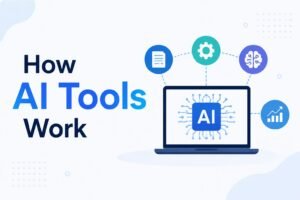
1. Data Collection and Processing
AI systems begin by collecting and organizing data. Data may come from websites, databases, applications, customer interactions, sensors, or business systems.
The quality of AI output depends heavily on the quality of the input data. Incorrect, incomplete, or outdated information can reduce AI accuracy.
Organizations should establish proper data management practices before implementing advanced AI solutions.
2. Machine Learning Models
Machine learning allows computers to identify patterns and improve performance through experience.
Instead of programming every possible situation manually, developers train machine learning models using large datasets. The system learns relationships between different variables and uses those patterns to make predictions.
Examples include:
- Predicting customer behavior
- Detecting fraudulent transactions
- Forecasting sales trends
- Improving search results
3. Artificial Intelligence Automation
AI automation combines traditional workflow automation with intelligent decision-making.
Traditional automation follows fixed rules:
Example:
“When a customer submits a form, send an email.”
AI automation can analyze situations:
Example:
“When a customer submits a form, identify their interest level, categorize the request, and recommend the next action.”
This makes AI automation more flexible compared with older automation methods.
Major Categories of AI Tools Explained
Generative AI Tools
Generative AI tools create new content based on user instructions. These systems use large language models or other AI architectures to generate responses.
Common uses include:
- Writing assistance
- Research support
- Image generation
- Software development assistance
- Document creation
Businesses use generative AI to improve productivity while maintaining human review for accuracy and quality control.
AI Productivity Tools
AI productivity tools help individuals and teams complete tasks more efficiently.
Examples include:
- Automated meeting summaries
- Email organization
- Task management assistance
- Document analysis
- Knowledge management systems
These tools reduce administrative workload and help professionals spend more time on higher-value activities.
AI Automation Tools
AI automation tools connect different applications and automate business processes.
A typical workflow may include:
| Process | Traditional Method | AI Automation Method |
| Customer inquiry | Manual response | AI-assisted response system |
| Data entry | Employee input | Automated extraction |
| Reporting | Manual preparation | Automated analysis |
| Lead management | Spreadsheet tracking | Intelligent CRM workflows |
AI automation is widely used in marketing, customer service, finance, and operations.
Business Applications of Droven IO AI Tools Concepts
AI in Marketing
Marketing teams use AI tools to analyze customer behavior, improve campaigns, and personalize communication.
Common applications include:
- Audience analysis
- Content optimization
- Customer segmentation
- Campaign performance reporting
- Predictive marketing insights
AI helps marketers understand what customers need while allowing teams to make decisions based on data rather than assumptions.
AI in Customer Support
Customer expectations for fast responses have increased. AI-powered support systems help businesses provide assistance at any time.
Common AI customer support applications include:
- Chatbots
- Automated ticket classification
- Knowledge base assistants
- Customer sentiment analysis
However, human support remains important for complex issues requiring empathy, judgment, and problem-solving.
AI in Software Development
Developers increasingly use AI tools to improve coding productivity.
AI-assisted development can help with:
- Code suggestions
- Bug identification
- Documentation generation
- Testing assistance
- Code explanation
Professional developers still need to review AI-generated code because security issues, logical errors, and performance problems may occur.
AI in Data Analytics
Organizations collect more data than ever before. AI analytics tools help transform raw information into useful insights.
Applications include:
- Sales forecasting
- Customer analysis
- Market research
- Risk assessment
- Operational optimization
AI analytics allows businesses to make faster decisions while reducing manual data processing.
Benefits of Using AI Tools for Individuals and Organizations
Artificial Intelligence tools provide practical advantages when they are implemented with clear objectives and proper management. The main value of AI comes from its ability to process information quickly, identify patterns, and assist users with complex tasks. Businesses and individuals can use AI technologies to improve productivity while maintaining human oversight.
AI adoption should focus on solving specific problems rather than using technology simply because it is available. A successful AI strategy begins by identifying business needs, selecting appropriate tools, measuring results, and continuously improving workflows.
1. Improved Productivity and Efficiency
One of the primary advantages of AI tools is their ability to reduce time spent on repetitive activities. Tasks such as organizing information, generating reports, analyzing documents, and managing workflows can often be completed faster with AI assistance.
For professionals, AI tools can act as digital assistants that support daily activities. They help users manage information more effectively and allow more time for creative thinking, strategy development, and problem-solving.
Important productivity benefits include:
- Faster completion of routine tasks
- Automated document processing
- Improved workflow organization
- Reduced manual errors
- Better resource allocation
2. Better Decision-Making Through Data Analysis
Organizations often collect large amounts of data but struggle to convert that information into useful insights. AI-powered analytics tools help identify trends, relationships, and potential outcomes.
For example, businesses can analyze customer behavior, sales performance, and operational efficiency to make informed decisions. AI does not replace decision-makers but provides additional information that supports strategic planning.
Data-driven decision-making helps companies:
- Understand customer preferences
- Identify business opportunities
- Predict future trends
- Reduce operational risks
- Improve planning accuracy
3. Enhanced Customer Experience
Customer expectations continue to change as digital services become more common. AI tools help organizations deliver faster and more personalized experiences.
AI-powered systems can analyze customer interactions and provide relevant recommendations or support. This improves customer satisfaction while allowing businesses to handle larger volumes of requests efficiently.
Examples include:
- Personalized product recommendations
- Automated customer responses
- Customer behavior analysis
- Voice assistants
- Smart search systems
Challenges and Limitations of AI Tools
Although AI provides significant advantages, organizations must understand its limitations. Artificial intelligence is not a perfect replacement for human expertise and requires responsible implementation.
A balanced approach considers accuracy, privacy, security, ethics, and operational requirements before deploying AI systems.
1. Data Privacy and Security Concerns
AI systems often require large amounts of data to function effectively. This creates challenges related to data protection, privacy regulations, and cybersecurity.
Organizations using AI tools should establish:
- Clear data handling policies
- Access control systems
- Encryption practices
- Compliance procedures
- Regular security reviews
Protecting sensitive information is essential because improper AI usage can expose confidential business or customer data.
2. Accuracy and Reliability Issues
AI systems can produce incorrect results when trained on incomplete, outdated, or inaccurate information. This is especially important for applications involving finance, healthcare, legal decisions, or critical business operations.
Human verification remains necessary to ensure AI-generated information is reliable.
Organizations should:
- Review AI outputs
- Validate important decisions
- Monitor system performance
- Update training data regularly
3. Implementation Costs and Technical Requirements
Adopting AI tools may require investment in technology infrastructure, employee training, and system integration.
Small businesses may face challenges such as:
- Limited technical expertise
- Budget restrictions
- Difficulty selecting suitable tools
- Integration with existing software
A gradual implementation approach can help organizations adopt AI without unnecessary complexity.
How to Choose the Right AI Tool
Selecting an AI tool requires careful evaluation. The best solution depends on the user’s goals, industry requirements, available resources, and security expectations.
A tool that works well for one organization may not provide the same value for another.
Important Factors to Evaluate
| Evaluation Factor | Questions to Consider |
| Purpose | What specific problem does the tool solve? |
| Accuracy | How reliable are the results? |
| Security | How does the tool protect user data? |
| Integration | Does it work with existing systems? |
| Scalability | Can it support future growth? |
| Cost | Does the value justify the investment? |
| Support | Is documentation and assistance available? |
Best Practices for Implementing AI Tools
Define Clear Objectives
Before adopting AI technology, organizations should identify measurable goals. A clear objective helps determine whether an AI solution delivers meaningful improvements.
Examples of measurable goals include:
- Reduce customer response time
- Improve reporting accuracy
- Automate repetitive tasks
- Increase operational efficiency
Train Employees and Encourage Collaboration
AI adoption works best when employees understand how to use technology effectively. Training helps teams recognize AI capabilities, limitations, and appropriate use cases.
Employees should learn:
- How to write effective instructions
- How to verify AI-generated information
- How to protect confidential data
- How AI supports their existing responsibilities
Maintain Human Oversight
Human expertise remains essential in AI-supported workflows. AI tools provide recommendations and automation, but professionals must evaluate results and make final decisions.
Human oversight improves:
- Accuracy
- Ethical decision-making
- Risk management
- Quality control
The Role of AI Tools in Digital Transformation
Digital transformation involves using technology to improve business processes, customer experiences, and operational models. AI has become a major component of this transformation because it enables organizations to become more adaptive and data-driven.
Companies integrating AI successfully usually combine technology with strong business strategies. They focus on improving processes rather than replacing human capabilities.
AI supports digital transformation through:
- Intelligent automation
- Advanced analytics
- Personalized customer experiences
- Faster innovation cycles
- Improved operational visibility
Droven IO AI Tools and the Future of Artificial Intelligence
The development of AI technology continues to accelerate. Future AI systems are expected to become more integrated, efficient, and specialized for different industries.
Emerging trends include:
| Future AI Trend | Expected Impact |
| AI Agents | Automated systems capable of completing multi-step tasks |
| Multimodal AI | Systems understanding text, images, audio, and video together |
| Responsible AI | Increased focus on transparency and ethical use |
| Industry-Specific AI | Customized solutions for healthcare, finance, education, and business |
| Edge AI | Processing data closer to devices for faster responses |
The future of AI will likely focus on collaboration between humans and intelligent systems. Organizations that understand AI fundamentals and implement technology responsibly will be better prepared for changing digital environments.
ALSO READ: Voozon: Complete Guide to Understanding the Platform, Features, Benefits, and How It Works
Frequently Asked Questions
What are Droven IO AI Tools?
Droven IO AI Tools refers to AI-related resources and discussions focused on artificial intelligence technologies, automation, machine learning, and digital innovation. These concepts help users understand how AI tools work and how they can be applied in different professional environments.
Are AI tools replacing human workers?
AI tools are primarily designed to assist humans rather than completely replace them. They automate repetitive tasks, analyze information, and provide support, while human professionals continue to provide creativity, judgment, and strategic thinking.
Are AI tools suitable for small businesses?
Yes, many AI tools are designed for small businesses. They can help automate customer service, marketing activities, administrative tasks, and data analysis without requiring large technical teams.
How can businesses use AI responsibly?
Businesses can use AI responsibly by protecting customer data, reviewing AI outputs, maintaining transparency, and ensuring human oversight in important decisions.
What skills are needed to work with AI tools?
Users benefit from skills such as:
- Digital literacy
- Data understanding
- Problem-solving ability
- Critical thinking
- Basic knowledge of AI concepts
Technical skills can be useful for advanced AI development, but many modern AI tools are designed for non-technical users as well.
Conclusion
Droven IO AI Tools represents the broader movement toward understanding and applying artificial intelligence in practical environments. AI technologies are influencing businesses, education, software development, marketing, analytics, and everyday digital experiences.
The effective use of AI requires more than selecting a tool. Organizations and individuals need clear objectives, reliable data, security practices, and human supervision to achieve meaningful results.
As artificial intelligence continues to develop, understanding AI fundamentals will become increasingly important. Platforms that educate users about AI concepts and applications help create better awareness, allowing people and organizations to make informed decisions about adopting emerging technologies.
AI is most valuable when it works alongside human expertise, improving efficiency while supporting better decisions, innovation, and responsible digital growth.
[…] provides results, team management, and event tools for the track and field and cross country communities. According to Athletic.net, the platform […]