
AI automation is changing the way work gets done — and it is happening faster than most people realize. From the chatbot that answers your customer service question at 2 a.m. to the spam filter that quietly sorts your inbox every morning, intelligent systems now handle tasks that once required continuous human effort. Yet for many people, the term still feels abstract or technical.
This guide cuts through that confusion. By the end, you will know exactly what AI automation is, how it works under the hood, the different forms it takes, where it is already being used, and where it is headed next. No unnecessary jargon. No inflated claims. Just clear, structured knowledge you can apply.
What Is AI Automation?
AI automation is the use of artificial intelligence to perform tasks with little or no human involvement. To understand it fully, you need to understand the two concepts it combines.
Automation refers to any system that completes a task on its own, following a set of pre-defined instructions. It removes the need for a person to manually carry out each step.
Artificial intelligence refers to systems that can learn from data, recognize patterns, reason through problems, and adapt to new situations — without being explicitly reprogrammed each time.
When you combine these two, you get AI automation: systems that not only act independently but also think, learn, and improve as they work.
Here is a simple contrast to make this concrete:
- A basic thermostat that switches on when the temperature drops below a set level is automation. It follows a fixed rule, nothing more.
- A smart thermostat that tracks your schedule, learns when you are home, and adjusts the temperature before you even arrive is AI automation. It understands your patterns and responds intelligently.
The core difference is adaptability. Traditional automation can only do what it was told. AI automation can figure out what needs to be done based on the situation it encounters.
How AI Automation Works
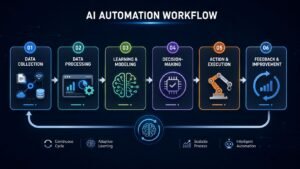
The inner workings of AI automation follow a clear, repeating cycle. Understanding this cycle helps demystify the technology and shows why it becomes more effective over time.
Here is the process, step by step:
- Data collection. Every AI system starts with data. The system gathers information from relevant sources — customer interactions, sensor readings, transaction records, website activity, or documents. Data is the raw material that makes everything else possible.
- Data processing. Raw data is rarely clean or ready to use. This step involves organizing, filtering, and correcting the data so the system can read it accurately. Poor data at this stage leads to poor decisions later.
- Learning and modeling. Machine learning algorithms analyze the processed data to identify patterns, relationships, and trends. This is the training phase. The system builds a model — essentially a set of rules it derived from the data — that it will use to handle future situations.
- Decision-making. With a trained model in place, the system encounters new data and applies what it learned. It predicts an outcome, classifies an item, recommends an action, or flags an anomaly — depending on what it was built to do.
- Action and execution. The system carries out the appropriate task automatically. This could mean sending a personalized email, approving a transaction, routing a support ticket, or generating a report — without waiting for a human to initiate it.
- Feedback and improvement. After acting, the system evaluates its own performance. If it made an error or received corrective feedback, it adjusts its model accordingly. This is the learning loop that makes AI automation increasingly accurate over time.
This cycle repeats continuously and at scale. That self-correcting loop is what fundamentally separates AI automation from basic scripted processes.
Core Technologies Behind AI Automation

Several distinct technologies work together to make AI automation function. You do not need deep technical expertise in each one, but a working understanding helps you evaluate tools and solutions.
- Machine learning (ML): The engine behind most AI systems. ML enables software to learn patterns from data and make predictions or decisions without being explicitly programmed for each scenario.
- Natural language processing (NLP): The branch of AI that allows systems to understand, interpret, and generate human language. NLP powers chatbots, email classifiers, voice assistants, and sentiment analysis tools.
- Computer vision: Enables machines to interpret and analyze visual information — images, video, and scanned documents. It is used in quality inspection, medical imaging, document processing, and facial recognition.
- Robotic process automation (RPA): Software that mimics human interactions with digital systems — clicking, copying, filling forms. On its own, RPA is rule-based. When paired with AI, it becomes capable of handling variation and making judgment calls.
- Deep learning: A subset of machine learning that uses layered neural networks to process complex data like images, speech, and text. It powers some of the most advanced AI capabilities available today.
Each technology handles a different type of problem. In practice, most AI automation systems combine several of these to deliver a complete solution.
AI Automation vs. Traditional Automation
One of the most common points of confusion is the distinction between AI automation and traditional automation. The table below makes the comparison straightforward.
| Feature | Traditional Automation | AI Automation |
| Decision-making | Follows fixed, pre-set rules | Makes decisions based on data and context |
| Adaptability | Cannot handle unexpected situations | Adapts to new and changing conditions |
| Learning ability | Does not learn or improve over time | Continuously learns from data and feedback |
| Data handling | Works with structured data only | Handles structured and unstructured data |
| Setup complexity | Simpler to design and deploy | Requires data preparation, training, and tuning |
| Best use case | Repetitive, highly predictable tasks | Complex tasks requiring judgment or pattern recognition |
| Example | Auto-reply email based on a keyword match | Chatbot that understands context and gives relevant answers |
The practical takeaway: traditional automation excels when a process never changes. AI automation is the right choice when the task involves variability, large volumes of unstructured data, or decisions that require context.
Many organizations use both. They apply traditional automation to stable, repetitive processes and layer AI automation on top when greater intelligence is needed.
Types of AI Automation
AI automation is not a single technology. It exists in several distinct forms, each designed for different types of tasks and organizational needs. Understanding these types helps you match the right solution to the right problem.
1. Rule-Based AI Automation
This is the simplest form and the most common starting point for organizations new to automation. It combines standard automation logic with basic AI capabilities like pattern recognition or keyword detection.
Rule-based AI automation can handle small variations in input — something traditional automation cannot do — but it still operates within a defined set of conditions. You will find it in email routing, basic fraud screening, and customer query triage.
It is a practical, lower-risk entry point. Most businesses start here and expand their AI capabilities as they gain experience.
2. Machine Learning Automation
This type uses algorithms trained on historical data to make predictions and decisions. The system improves as it processes more examples, gradually becoming more accurate and reliable.
Common applications include product recommendation engines, predictive maintenance in manufacturing, credit scoring in financial services, and demand forecasting in retail. Machine learning automation delivers the most value when you have access to large, clean, and well-labeled datasets.
The more relevant data you feed it, the better it performs. It is a compounding investment — accuracy builds over time.
3. Cognitive Automation
Cognitive automation aims to replicate higher-order human thinking. It combines NLP, computer vision, and advanced reasoning to handle complex, unstructured tasks that have historically required human expertise.
A cognitive automation system can read a legal contract, identify key clauses, extract obligations, and flag anomalies — tasks that once required a trained professional to complete manually. Virtual assistants, intelligent document processing, and knowledge management tools all fall into this category.
This type of automation is particularly valuable in knowledge-intensive industries like law, healthcare, insurance, and finance.
4. Intelligent Process Automation (IPA)
IPA is the most comprehensive form. It integrates RPA with machine learning, NLP, and process orchestration to automate entire workflows — not just isolated tasks.
Consider an accounts payable workflow. IPA can receive an invoice by email, extract the relevant data using NLP, validate it against purchase order records, flag discrepancies for review, and schedule payment — all without human involvement at any step.
IPA is best suited for complex, cross-functional processes where multiple systems, data sources, and decision points are involved.
Real-World Examples of AI Automation
AI automation is not theoretical. It is already operating across industries, handling tasks that affect millions of people every day.
- Customer service: AI-powered chatbots and virtual agents handle routine inquiries around the clock. They resolve common questions instantly and route complex issues to human agents, reducing wait times and operational costs.
- Healthcare: AI systems analyze X-rays, MRIs, and pathology slides to support earlier and more accurate diagnoses. Administrative tasks like appointment scheduling, prescription refills, and patient record updates are also increasingly automated.
- Financial services: Banks and payment processors use AI to detect fraud in real time. The system monitors transaction patterns continuously and flags anomalies within milliseconds — far faster than any human reviewer could.
- E-commerce: Recommendation engines analyze your browsing history, purchase behavior, and demographic data to suggest products you are likely to buy. This personalization drives measurable increases in conversion rates.
- Manufacturing: Computer vision systems inspect products on the assembly line at speeds and accuracy levels that human inspectors cannot match. Defects are caught earlier, reducing waste and improving product quality.
- Marketing: AI tools segment audiences, personalize email content, optimize ad targeting, and determine the best time to send a message — all automatically, and at a scale that no human team could operate manually.
- Human resources: AI automation screens resumes, schedules interviews, and analyzes candidate assessments, helping HR teams focus their time on higher-value interactions.
What each of these examples shares is a consistent outcome: faster execution, fewer errors, and human effort redirected toward work that requires genuine judgment.
Benefits of AI Automation
When implemented well, AI automation delivers concrete, measurable advantages. Here is what you can realistically expect.
- Greater efficiency. Repetitive, time-consuming tasks are completed in seconds rather than hours. Your team spends less time on low-value work and more time on decisions that require human thinking.
- Fewer errors. Automated systems do not lose focus, rush through tasks, or make transcription mistakes. They perform the same process with the same accuracy every time.
- Lower operating costs. By handling high-volume tasks without additional headcount, AI automation reduces labor costs as your operation scales. The return on investment typically grows over time.
- Stronger decision-making. AI processes data at a volume and speed no human team can match. It surfaces patterns and insights that would otherwise go unnoticed, leading to better-informed decisions.
- Scalability without proportional cost. As your business grows, AI automation absorbs increased workloads without requiring a corresponding increase in staff. You scale your output without scaling your costs at the same rate.
- Continuous availability. AI systems do not keep business hours. Your customers receive service, and your processes keep running, at any time of day or night.
- Consistent customer experience. Automation removes the variability that comes with human performance on any given day. Every customer interaction follows the same standard.
Challenges and Limitations of AI Automation
A clear-eyed view of AI automation includes its limitations. Understanding these challenges in advance allows you to plan for them rather than be surprised by them.
- Data dependency. An AI system is only as reliable as the data it trains on. If your data is incomplete, outdated, or biased, your system will produce unreliable or unfair results. Data quality is not optional — it is foundational.
- High initial investment. Building, training, and deploying AI systems requires meaningful upfront investment in technology, infrastructure, and skilled personnel. Smaller organizations need to plan carefully to justify this cost.
- Skill requirements. Effective AI automation demands people who understand data science, machine learning, and system integration. This talent is in high demand and can be difficult to hire or retain.
- Integration complexity. Connecting AI tools to legacy systems, disparate databases, and existing workflows is rarely straightforward. A rushed integration often creates more problems than it solves.
- Ethical and privacy risks. AI systems make decisions that affect real people. Bias in training data can produce discriminatory outcomes. You have a responsibility to ensure your systems are fair, transparent, and compliant with data privacy regulations.
- Workforce concerns. Automation displaces some tasks, which can create anxiety and resistance within teams. Managing this transition thoughtfully — with clear communication and retraining programs — is essential.
Address these issues at the planning stage. Organizations that treat them as afterthoughts consistently face higher costs and slower adoption.
How to Get Started With AI Automation
If you are ready to explore AI automation for your organization, follow a structured approach. These steps reduce risk and build confidence at each stage.
- Map your repetitive tasks. Identify the processes in your operation that are time-consuming, follow a consistent pattern, and are prone to human error. These are your strongest candidates.
- Define measurable goals. Be specific about what you want to achieve. Reduce processing time by 40 percent. Cut error rates to under one percent. Lower cost per transaction by a defined amount. Vague goals produce vague results.
- Run a focused pilot. Select one process and automate it end to end. A contained pilot limits risk, generates real data, and gives your team hands-on experience before you commit to a larger rollout.
- Invest in data preparation. Clean, label, and organize the data your system will use. This step is less exciting than the technology itself, but it determines whether your system succeeds or fails.
- Choose tools that match your capacity. If your team lacks technical expertise, start with no-code or low-code platforms. If you have in-house engineering resources, you have a wider range of options.
- Measure against your baseline. Track performance before and after automation. Use the data to validate your results, identify gaps, and make targeted improvements.
- Expand systematically. Once your pilot delivers results, apply the same process to additional workflows. Use what you learned in the pilot to move faster and with more confidence.
Each step builds on the last. This progression keeps the investment manageable and the results verifiable.
The Future of AI Automation
The pace of development in AI automation is accelerating. Several trends are already shaping what the next few years will look like.
- Hyperautomation. Organizations are moving beyond automating individual tasks toward automating entire process ecosystems. AI, RPA, process mining, and analytics are converging into unified platforms that automate everything that can be automated.
- Generative AI integration. Large language models capable of generating text, code, and analysis are being embedded into automation workflows. This extends automation into knowledge work — drafting reports, writing code, summarizing documents — that previously required human expertise.
- Autonomous AI agents. The next generation of AI systems can manage multi-step tasks independently. These agents plan, execute, monitor, and adjust their actions without human supervision at each step.
- Democratized access. No-code and low-code tools are lowering the barrier to entry. Business users with no programming background can now build and deploy automation workflows using drag-and-drop interfaces.
- Regulatory frameworks. Governments and industry bodies are developing clearer rules around AI transparency, accountability, and data privacy. Responsible use of AI automation will shift from a best practice to a legal requirement in many jurisdictions.
The direction is consistent: AI automation will become more capable, more accessible, and more deeply integrated into the systems and processes that organizations depend on.
Conclusion
AI automation is the combination of artificial intelligence and process automation to complete tasks that require learning, reasoning, and adaptation. It goes beyond following fixed rules. It understands context, makes decisions, and improves with every cycle.
You now have a clear picture of what it is, how it works, the major types, where it operates across industries, what it delivers, and what challenges to prepare for. You also have a practical, step-by-step path to get started and a grounded view of where the technology is heading.
The most important principle is to start deliberately. Choose a specific task, set a measurable goal, prepare your data, and run a controlled pilot. AI automation is not about removing people from work. It is about removing people from the work that machines can do better, so your team can focus on the work only humans can do. Approach it with structure and realistic expectations, and the results will follow.
Frequently Asked Questions
What is AI automation in simple terms?
AI automation is technology that uses artificial intelligence to complete tasks independently. Unlike basic automation that follows rigid rules, AI automation can learn from data, adapt to new situations, and improve its accuracy over time — all without being manually reprogrammed.
How is AI automation different from traditional automation?
Traditional automation follows a fixed set of instructions and cannot handle unexpected situations. AI automation adds intelligence to the process, allowing the system to learn from data, recognize patterns, and make decisions in situations it was not explicitly programmed for. The result is a system that handles complexity and variation, not just repetition.
What industries benefit the most from AI automation?
AI automation delivers strong results across many industries. Financial services, healthcare, e-commerce, manufacturing, marketing, and customer service are among the most active adopters. Any industry with high-volume, data-intensive processes stands to benefit.
Is AI automation accessible to small businesses?
Yes. A growing number of no-code and low-code platforms make AI automation available to organizations of any size. You do not need a dedicated engineering team to get started. Many tools are priced on a subscription basis, making the entry cost manageable.
What skills are needed to implement AI automation?
For no-code tools, you need solid process knowledge and the ability to define clear goals — no programming required. For more advanced or custom systems, expertise in data management, machine learning, and systems integration becomes important. Many organizations also work with external consultants or technology partners to bridge skill gaps.
Will AI automation eliminate jobs?
AI automation changes the nature of work rather than eliminating it entirely. It takes over repetitive, rule-based tasks so people can focus on higher-value activities that require creativity, judgment, and interpersonal skill. The organizations that manage this transition well invest in retraining and clearly communicate how roles will evolve.
How much does it cost to implement AI automation?
Costs vary significantly depending on the scope and complexity of your project. Entry-level subscription tools may cost a few hundred dollars per month. Custom enterprise systems can require substantial upfront investment in technology, infrastructure, and talent. Starting with a small pilot project is the most effective way to control costs while proving value.
What is the single most important step before automating a process?
Define a clear, measurable goal. Before you choose a tool or write a single line of code, you need to know exactly what success looks like. Whether that is reducing processing time, lowering error rates, or cutting costs by a specific amount — a defined target keeps the project focused and makes it possible to evaluate results objectively.
[…] has moved from science fiction to daily reality. GizmoCrunch tracks AI developments, practical applications, and their broader industry impact. That includes generative […]
[…] ALSO READ: What Is AI Automation? A Beginner’s Guide […]